What is Jet Lag: Hide and Seek?

Remember those games of Hide and Seek you used to play as a kid? Jet Lag: Hide and Seek is like that, but on a much bigger scale. City-wide. country-wide, even. It's a childhood favourite reimagined for grown-ups who want to have some fun on public transport.
I've written a few things, both on Fedi and here about Jet Lag Hide and Seek, and I inevitably get asked what the game is. This page is a way to respond to that easily, and give a basic overview of the rules.
Jet Lag: The Game
This game is published by the designers and producers of the Nebula and YouTube channel Jet Lag: The Game, in which Sam Denby, Ben Doyle and Adam Chase, all from Wendover Productions, and occasionally joined by other Nebula or YouTube content creators, and play games designed by them that mirror old games we used to play as children: Connect 4, Tag, Capture the Flag, and so on, as well as some less recognisable formats that have been invented by themselves. The twist is that the games are heavily reliant on public transport. Orignally with planes (hence the name), but also a huge amount of time spent on trains.
These games also make heavy use of cards with challenges on them in order to win points and be able to progress in the game.
The games are very much about travel, the locations, and fun. As well as being good game designers, they are good videographers, and know how to put together something beautiful and funny, and keep an audience engaged.
Hide and Seek
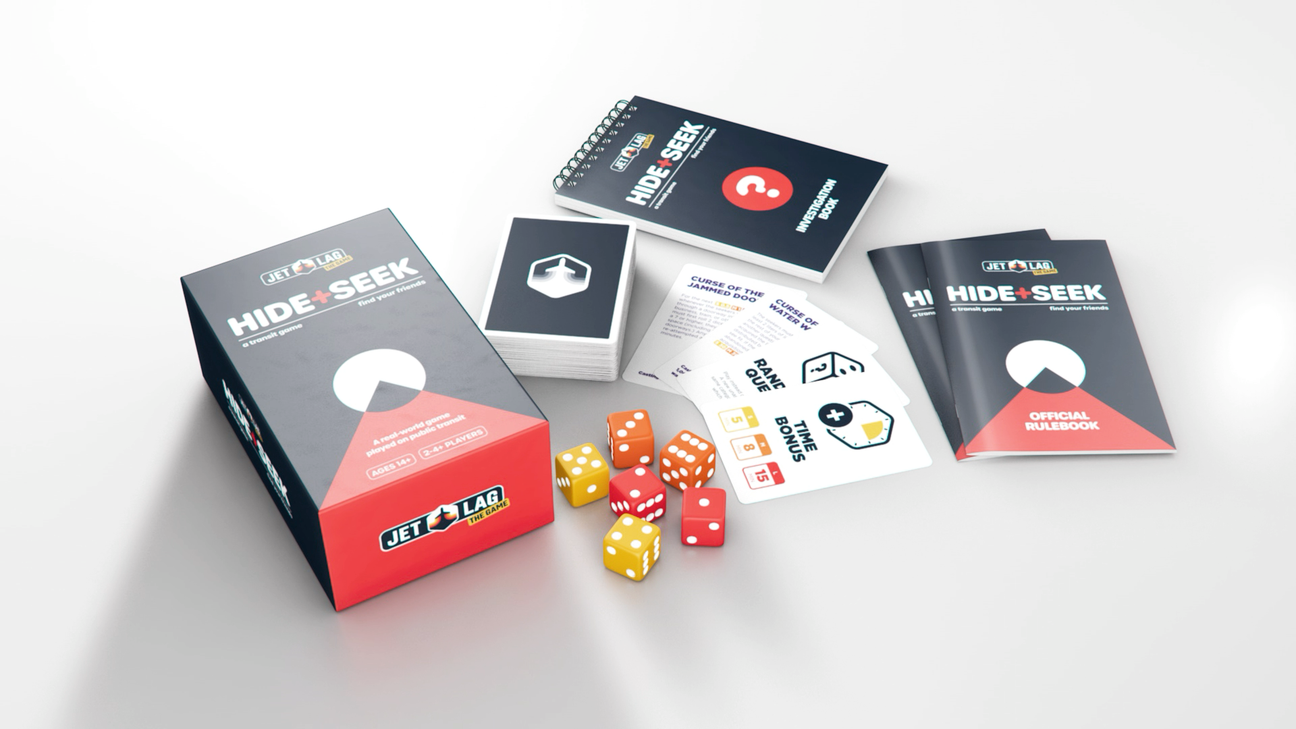
This game was prototyped and in Switzerland, and then completely revamped in order to play it in Japan, they also played a small game in New York. The cards, manual, etc are now sold as a game to play "at home" with your friends, which is what I do.
It has three variants: Large (the size of a country), Medium (the size of a large city), and Small (part of a city, a collection of towns, that sort of thing). At the time of writing, we've played a Large game in Germany, two Medium games in Barcelona, and a Large game in the Netherlands.
The game is designed to be played with 2-4 players, but really shines with three: a team of two Seekers and a Hider.
The Hider gets a certain amount of time (Large: 3 hours, Medium: 45 minutes, Small: 30 minutes) in which to travel to their Hiding Zone, which must be in a (Large) 1km or (Medium, Small) 500m radius from a station or transit stop. The players agree on the map limits and the types of trasport that are allowed before the game starts.
Seeker Questions
Once that time is over, the Seekers start asking the Hider a number of questions from a set list of questions, there are six types:
- Matching: Is your something the same as our something? e.g. is your closest golf course the same as our closest golf course?
- Measuring: Are you closer to something than we are? e.g. are you closer to an airport than we are?
- Radius: Are you within x metres of my current location? e.g. are you within 2km of my current location?
- Thermometer: We've moved x metres, are we warmer or colder? e.g. we've moved 1km, are we warmer or colder?
- Tentacles: Of all the something within a x km radius, which is your closest one? e.g. Of all the libraries within a 2km radius, which is your closest one?
- Pictures: Send us a picture of something. e.g. Send us a picture of the largest building visible from the station
The somethings are also set as part of the rules.
As you can tell, the Seekers' location is an important part of these questions, and so they must travel in order to position themselves to get the best possible answer to the questions, and thus narrow down possible locations on the map. The Hider has a tracker on the seekers, so they know where they are most of the time.
Once the Seekers have arrived at the Hider's transit station, this is known as the "End Game" and the Hider is not allowed to move.
The round ends when the Seekers find the Hider. At that point all the time bonuses are added up, and added to the time spent in finding the Hider. Then the Hider and Seekers rotate for another round. At the end of the game, the Hider with the longest hiding time is the winner.
This game, in its large variant, can take days to play. We normally set a hard limit of one day per hider, but the rules allow for it to be extended.
The Hider Deck
Each time a question is asked, the Hider gets to draw and keep some cards. These cards contain time bonuses, power-ups and curses. The curses are a significant part of the fun of the game, as they can significantly slow down the Seekers' progress if played correctly.
The game comes with a set of standard curses that are pretty generic, but the creators encourage you to make your own that are more appropriate for your group dynamic and location, and even provide a large number of blank cards for the deck. So my friends and I have been making our own cards to add to the deck.
The main limitation on curses is that if a curse blocks the seekers from asking questions or moving on public transport, another curse cannot be played upon them.
Where to buy
You can buy this game from the Nebula Store, although it's been quite difficult to get hold of reliably.
Read More About It
Whenever I play a game, I toot about it on my Mastodon account
I will eventually link my mastodon threads individually here, but I can point you to my #JetLagTheGame hashtag on Mastodon for now...
Similarly, after each game or games, we've gotten together and thrashed out our opinions on where the game went right and wrong. We call it Intercity Insights. You can see these write-ups in the Jet Lag tag.
Finally, there is the unofficial subredddit r/jetlagthegame where these games are discussed unde the tag "Home Game"